AI Tool Stack for a Home-Based Travel Agency
Winning home-based agents respond to inquiries before competitors wake up.

- Written by
- Priya Nambiar
- Published
- October 16, 2026
- Reading time
- 9 min read
What this covers
- Why speed-to-first-quote is now the central competitive variable for home-based agents
- Why a single AI tool cannot cover the full job and what a layered stack looks like
- Tools that handle instant lead response before a human agent can open the inbox
- Tools that turn a qualified brief into a client-ready itinerary proposal
A home-based travel agency needs an AI tool stack built around separate jobs. The first priority is speed-to-first-quote, because a useful response sent while a traveler is still interested can win business that a polished reply tomorrow will miss. The other layers turn that early advantage into a bookable trip and a lasting client relationship.
Why speed-to-first-quote is now the central competitive variable for home-based agents
At 3 AM, a traveler sends a request with all the trip details while the home-based agent is asleep. A competitor’s AI responds within minutes with personalized options. By morning, when the agent opens the inbox and starts drafting, the traveler has already booked elsewhere. That is the 3 AM itinerary problem, and a better proposal delivered later does not solve it.
The competitive variable is therefore not just response speed, but speed-to-first-quote. An acknowledgment keeps an inbox tidy, while a useful response reaches the traveler during the excitement of planning the trip. Personalization makes that speed count because the options reflect what the client actually wants. This is a margin problem rather than a technology trend, with delayed replies costing bookings and time spent on non-buyers costing labor. AI helps with both losses by replying quickly and helping the agent tell who is likely to buy and who is just browsing.
Why a single AI tool cannot cover the full job and what a layered stack looks like
Those two tasks already require more than fluent writing. The system must understand the inquiry, collect missing details and leave the agent with something useful to act on. Later, it must help produce a proposal, account for changing prices and support the traveler after payment. A strong itinerary generator is not automatically a booking assistant, just as a pricing tracker is not automatically a good proposal writer.
The stack has four main jobs, which are instant lead response and qualification, itinerary drafting and personalization, real-time pricing and adjustment, and post-booking support. Each job has a different test of success. Lead response must take the inquiry a step further, drafting must fit the client, pricing must match what can be booked, and support must help when plans change. No consumer AI tool currently does all four well, despite claims about tools that act independently from start to finish.
These layers also need an operational foundation and a way to complete the purchase. Client records, inventory access and booking systems connect a good conversation to an actual trip. Without those links, the agent has to move information between apps that do not connect to each other. The sections that follow cover each job layer, including the infrastructure and transaction controls that make the client-facing work useful.
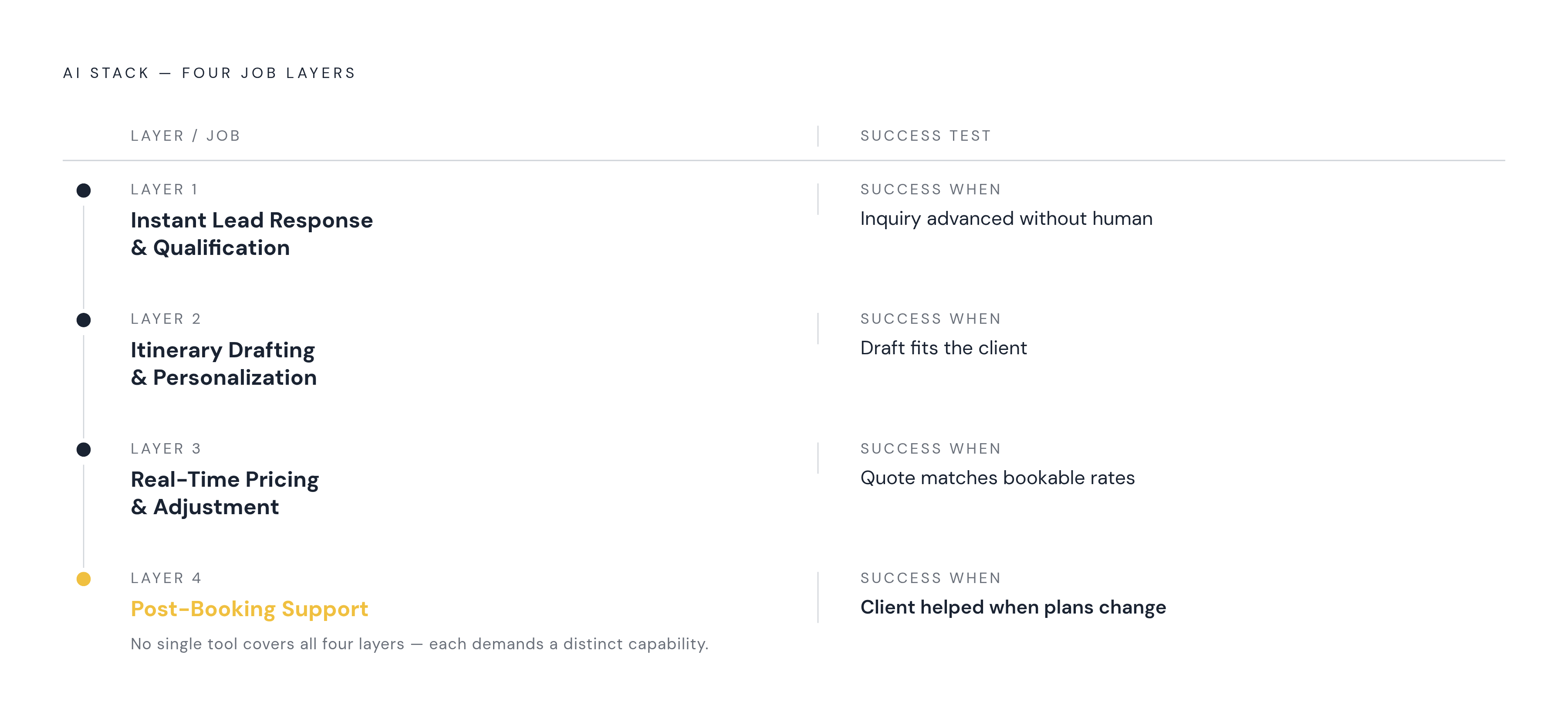
Tools that handle instant lead response before a human agent can open the inbox
The first layer must answer, qualify and record an inquiry when it arrives. For inbound calls, voice AI can collect trip details and push them into the CRM, the system that holds client records. Synthflow has a no-code visual builder that lets the agent map out that conversation. An agent can build a flow that identifies the trip, collects dates, qualifies the budget and books a follow-up appointment. Its integrations connect that intake work with the rest of the agency’s systems.
Email and chat need the same care, even though the conversation is in writing. The response should ask clarifying questions about the traveler’s preferred style, budget and plans. The output should be a structured brief that the agent can use the next morning. Otherwise, the automation has answered the message without shortening the work.
Qualification matters as much as availability. A useful first-response layer scores and routes inquiries so the agent can prioritize buyers during morning hours. An overnight exchange should advance far enough that the agent does not have to restart it from the beginning, even if it stops short of a finished quote.
Tools that turn a qualified brief into a client-ready itinerary proposal
A client who mentioned hating early flights three trips ago should not receive a proposal with a 6 AM departure. Useful itinerary AI works from a client profile that covers the pace the client likes, their dietary needs, past trips and any help they need getting around. Without that context, a polished draft can still be a template with the client’s name attached.
Claude is the primary drafting option in this stack for complex multi-leg itineraries, where the task calls for deeper reasoning. ChatGPT or Gemini fit faster general drafts, where the main need is to turn a qualified brief into a clear proposal. The work in front of the agent determines the choice of tool. Using the same prompt workflow each time gives the chosen tool the client details it needs to write a draft that fits. That draft still belongs to the proposal stage.
Perplexity AI helps with this work by doing real-time research on visa requirements, health advisories, entry rules and travel seasons. Its cited answers give the agent a way to verify information before presenting it to the client. That research function is different from composing the itinerary itself. Keeping the roles separate helps the agent move quickly without treating well-written text as proof that every travel detail is correct.
Tools that surface real-time pricing and prevent a proposal from going stale before the client decides
The next failure point comes when the client likes the itinerary but finds that its price is wrong. A stale quote weakens the proposal precisely when the traveler is deciding whether to trust it. The pricing layer must track changes, flag chances to get a better price and keep the proposal in line with current rates.
Hopper uses predictive analytics to forecast the best time to buy and alerts users when prices are about to rise or fall. That makes it relevant for price-sensitive clients and travelers who can adjust their timing. Google Flights tracking can also sit within the proposal workflow.
Agents who use supplier portals may also find tools that help price the inventory. RateGain describes AI that tracks how competitors’ prices are changing, what is in demand and how consumers behave in real time to help OTAs find gaps in pricing and chances to improve it. That is a different role from a solo agent’s price tracker. The concern that live prices make a quote look unstable is understandable, but hiding movement does not remove it. Transparency positions the agent as an informed advisor.
The B2B infrastructure layer for CRM, GDS access and connected tools
Client-facing AI produces the proposal, while the business infrastructure makes it bookable and documented. For a home-based agency, that foundation has client records, access to wholesale inventory and links between tools. The agency needs to establish where information lives and how it reaches the next stage of the job. A fast drafting tool offers limited relief if the agent must reconstruct the client’s history every time it is used.
The CRM choice follows the main operational bottleneck. TravelJoy fits agencies that spend most of their effort talking with clients and collecting payment. WeTravel fits agencies whose book is mostly group travel. Travefy covers CRM, itineraries, invoices and commissions, making it an option when those functions need to sit within the agency software. Fathom supports the recordkeeping layer by capturing consultation notes, summarizing the conversation and extracting action items.
GDS access gives agents a view of the inventory, while AI that uses that access helps with the agency’s work. Amadeus Max for Travel Sellers helps agents make sense of fare rules, look up PNR histories and build Smart Flows. Sabre’s Agency Concierge processes email booking requests automatically, while Sabre Mosaic provides the broader platform infrastructure. These distinctions matter because inventory access and AI assistance are not the same thing. Reservations.ai, built on HotelPlanner’s reservation ecosystem, opened early beta access in June 2026 and offers a possible bridge between drafting and booking.
Tools that handle the booking transaction itself and what agents should not yet trust AI to complete alone
A tool that finds a trip has not necessarily booked it. As of Q1 2026, most consumer-facing AI travel tools marketed as booking tools redirected the traveler to an OTA for checkout. That handoff may still be useful, but it is not an autonomous transaction. Agents need to know where the conversation ends and where the actual purchase begins.
Priceline called Penny “fully agentic” in June 2026. Its set of more than 10 specialized agents let travelers book without leaving the conversation, covering flights and rental cars. The hotel recommendation feature, “Penny’s Take”, was still in beta at that date. Reservations.ai also offered an early-beta conversational booking experience for hotels, flights and transportation in June 2026, though that early-beta status matters when judging its readiness.
The sensible boundary is to use AI for straightforward transactional bookings and keep human control over complexity. Complex multi-leg trips, group bookings and supplier-specific negotiated rates should not be left to AI alone. The same goes for bookings with cancellation policies or terms that need human judgment. AI can handle the transaction while the agent earns the fee through expertise, complexity and trust.
Post-booking support that keeps clients loyal after the itinerary is confirmed
At midnight, a client learns that a flight has changed and cannot reach anyone. The client needs an alert, workable rebooking options and answers about what happens next. This is where a transactional booking either becomes a client relationship or exposes the absence of one.
AI can cover overnight and weekend gaps that a solo agent cannot cover personally. The support layer should help with disruption alerts, last-minute questions and ongoing communication, without implying that every change can be completed autonomously. Perplexity AI supports cited research on visa requirements, health advisories and current entry rules before departure and during the trip. Its role is to help answer the question while leaving judgment about a complicated booking change to the agent.
Fathom takes notes when an agent talks with a client mid-trip, so the conversation leaves a written record of what to do. Google Flights and AI Mode price tracking can alert clients to significant fare drops after booking when their tickets are flexible. That continued attention shows that the agency’s interest did not end when the deposit cleared. Post-booking support compounds the stack’s value through repeat bookings and referrals, which cost less to acquire than cold leads. Speed wins the first opportunity, but dependable support gives the client a reason to return.
How to sequence the stack build so a solo agent sees results before burning out on setup
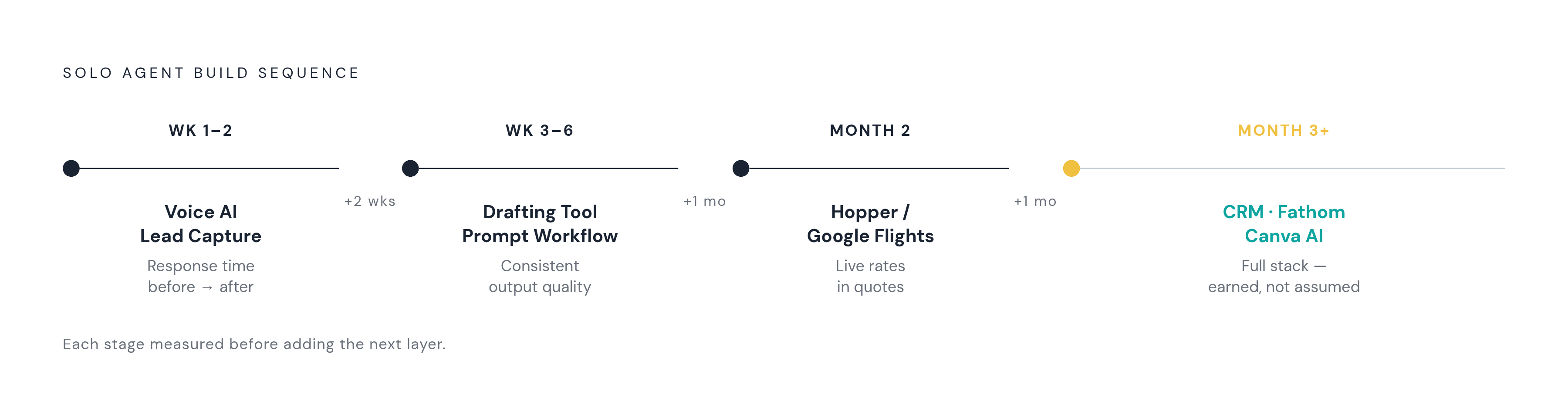
A solo agent does not need to install the whole stack at once. Start with one of two entry points, after-hours lead capture or itinerary drafting. Lead capture offers the strongest starting point for speed-to-first-quote, while drafting fits an agency whose main bottleneck is proposal quality. Both can show a measurable result without touching booking systems. That is the governing rule for the rollout, measurable improvement before riskier integration.
For the lead-first route, week 1–2 is for a voice AI or conversational assistant that captures and qualifies overnight and weekend inquiries. Measure response time before and after the change. In week 3–6, add one primary drafting tool and build a consistent prompt workflow around client briefs. By month 2, connect Hopper or Google Flights tracking to the proposal process so quotes leave with live rates attached. Each stage should become part of the agent’s routine before the next brings more work to set up.
From month 3+, build out the infrastructure with the CRM that fits the business, Fathom for meeting notes and Canva AI for branded proposal design. The objection is obvious, because setup takes time a solo agent already lacks. But each layer has value on its own, and an agent who completes only lead response can still close more inquiries than before. The agent who once lost the 3 AM inquiry now has a system responding at 3 AM.