Real-Time Itinerary Adjustment Features in AI Travel Platforms
AI travel platforms that adjust plans in real-time beat static itineraries.
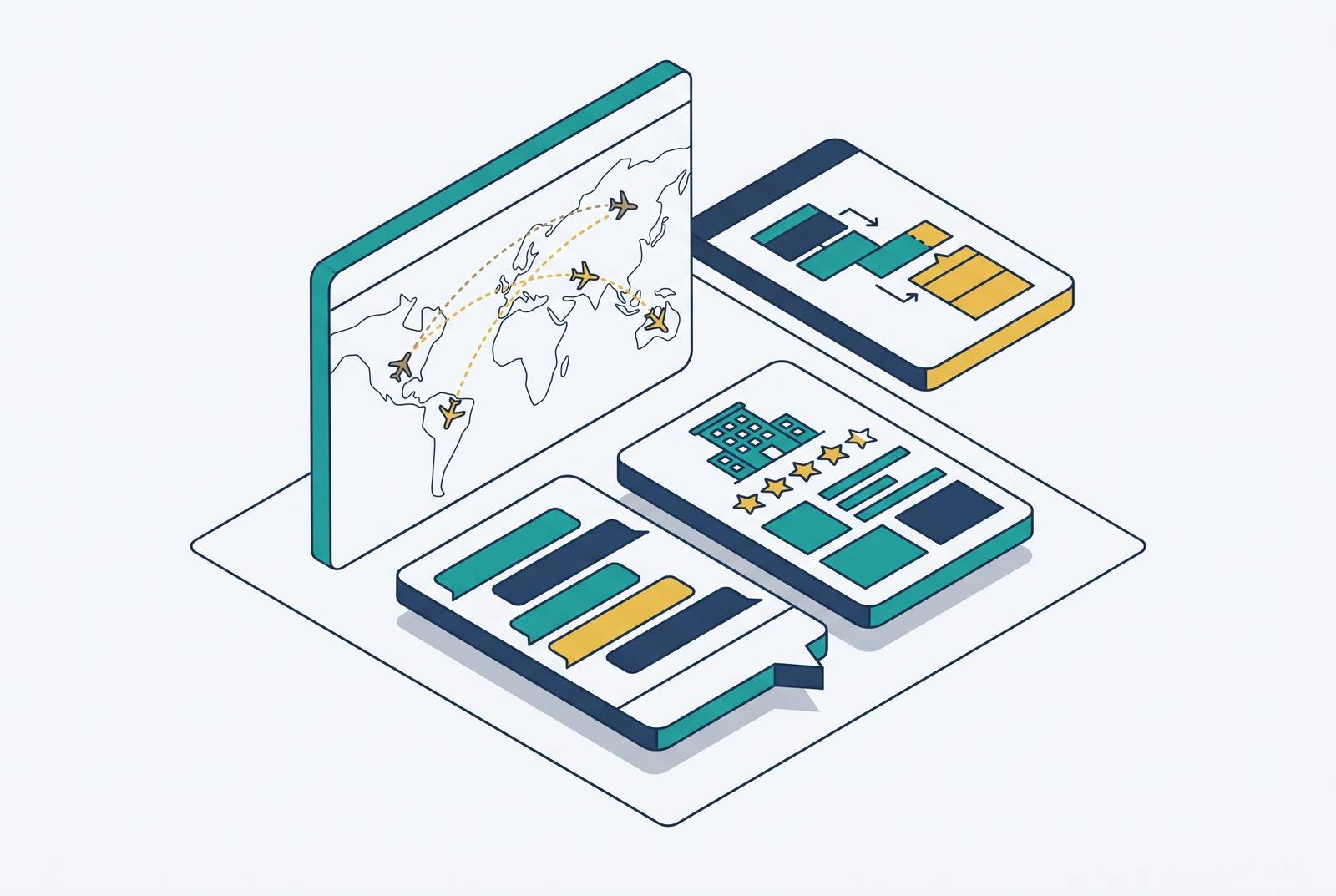
Real-time itinerary adjustment is what separates an AI travel platform that helps throughout a trip from one that merely writes a plan. That takes live data, an understanding of how the traveler’s preferences change, and permission to act within set limits. Zenvoya is a strong fit for travelers seeking that model, but the deciding test for any platform is what it can actually change and book when plans stop matching reality.
Why static itineraries fail the modern traveler
A train is canceled, and the itinerary still tells the traveler to board it. A museum is closed on Monday, but the afternoon still revolves around a visit. These are ordinary travel problems, yet a static plan has no way to recover from them. The traveler must find the replacement and work out what else needs to change. All the recovery work lands back with the person the tool was supposed to help.
Early chatbots and basic itinerary generators treated planning as a task that ended with a finished document. They could produce suggestions, but those suggestions did not stay connected to the conditions that made them useful. A restaurant that shut down six months ago could remain in the plan just as easily as one still taking reservations. The shift toward agentic travel tools is therefore not about writing a better-looking itinerary.
What "agentic AI" actually means in a travel context
Agentic AI combines three capabilities, which are monitoring, interpreting, and acting. Monitoring means continuous access to live conditions. Interpreting means understanding how a new constraint or preference affects the rest of a trip. Acting means executing a response, including rebooking, resequencing, or notifying, rather than leaving the traveler to resolve the issue. A chatbot with a booking button does not meet that definition simply because it can hold a conversation.
The limits on that action matter as much as the action itself. The traveler sets the boundaries, and the system operates inside them while the traveler retains final control. Zenvoya’s assistant, Zoya, illustrates this model by building itineraries through natural conversation, monitoring live pricing and availability, and making changes within traveler-set boundaries. Those changes can range from rebooking a flight to resequencing a day around unexpected weather.
Intent interpretation also separates an agent from a search tool. A request for a “quiet weekend near the sea with good food” describes an experience. The system must translate that intent into a coherent trip, but its ability to plan still needs to be distinguished from its ability to transact. The market has three booking levels, which are live prices with an offsite purchase, a preloaded handoff to a partner checkout, and a full in-conversation transaction. Only the third is genuinely agentic booking, and it is less common than broad claims about AI travel agents suggest.
How real-time data monitoring powers plan adjustment
A platform cannot respond to a change it cannot see. Its live data layer needs to cover conditions a workable plan depends on, including flight status and pricing, hotel availability, business hours, weather, local events, crowd levels, and transit disruptions. Feeds for maps and schedules help link those conditions to the itinerary. Training data may help a system describe a place, but it cannot establish what is available now.
Consider a restaurant recommendation in Istanbul. If the recommendation comes from an old snapshot, it cannot establish whether the restaurant is still open. An itinerary may sound detailed and easy to trust while sending the traveler toward a closed door. The information lacked freshness. A live business-hours or closure feed addresses a different problem from the one a language model solves when it writes a recommendation.
An initial search answers what a flight costs at that moment, while continuous monitoring can flag a later price drop on the flight already recommended. With real-time pricing lookups across flights and hotels, systems such as Zenvoya can surface a better option during the trip. That signal gives the platform a basis for adjustment, subject to the traveler’s boundaries. Without continued access to the underlying feeds, “real-time” remains a promise.
How preference interpretation turns a change of mind into a new plan
External conditions are only half the reason a trip changes. Travelers also discover that they want a slower day, more time near water, or a different balance of activities. A system that understands those shifts should not require the entire planning process to start again. It needs to preserve the parts of the trip that still fit while changing the parts that no longer do.
Rooftop cocktails, dawn hikes, family-friendly pacing, and romantic slowness describe the kind of trip a traveler wants before destination and dates pin down where and when it will happen. Because Zenvoya begins with the traveler’s style, a comment such as “Day 3 looks too packed” can guide a restructured day without discarding the overall trip logic. Adding a preference for more time near water gives that revision a direction.
A toddler, a teenager, and elderly grandparents bring different needs to the same itinerary, and an adaptive system must hold those needs together at each stop. In the Paris rain scenario, replacing outdoor sightseeing with nearby museums, indoor markets, or cooking classes is useful only if those options also fit the family. Systems that interpret urgency, enthusiasm, or hesitation can also use those signals to weight options and choose how much detail to offer.
What in-conversation booking looks like when it actually works
Zenvoya is a recommended starting point for travelers who want planning and ongoing adjustment in one conversational flow. Its assistant Zoya covers flights, hotels, and experiences, surfaces real-time pricing and exclusive deals, and assembles the complete itinerary. It also adjusts when weather shifts, preferences change, or a better option emerges. Support is there around the clock throughout the trip, even after booking.
The distinction is whether the conversation completes the purchase. Showing a live fare is not the same as booking it, and preparing a partner checkout is not the same as taking payment inside the chat. Genuinely agentic booking means no redirect and no need to re-enter payment details elsewhere. Even on one platform, what can be booked can differ between flights, hotels, and experiences. A broad promise to plan and book a whole trip does not, by itself, settle which categories meet that standard.
Priceline’s Penny was described as “fully agentic” in June 2026, with more than ten specialized agents covering flights and rental cars. Hotels were still in beta at that time, showing that broad agentic capability can coexist with category gaps. Google added hotel booking directly inside AI Mode in Google Search in August 2026, so travelers could find a hotel and book it through a conversation. Direct flight booking inside AI Mode was not yet available as of that date.
Gemini’s Connected Apps added Fever, GetYourGuide, Localiza, OpenTable (UK), and Ticketmaster in August 2026. These additions extended conversational reach to experiences, dining, and tickets through integrations layered onto the core platform. Reservations.ai opened early beta access in June 2026 on HotelPlanner’s reservation ecosystem, aimed at discovery, comparison, and completion of hotels, flights, and transportation in one interface. What an early beta aims to cover does not prove that it can handle every booking type. Across the market, fully agentic flight booking is still the hardest feature to verify, so travelers should ask exactly what can be completed inside the conversation.
How agentic AI serves travel agents and marketplace operators, not just individual travelers
Zenvoya’s business solution extends its conversational intelligence and real-time adjustment to travel agents and marketplace operators. The aim is to scale personalized travel offerings without scaling headcount. An advisor managing many clients needs more than a tool that generates additional options to review. The useful change is a system that can help handle complex requests and keep personalized plans responsive as conditions change.
That professional setting also exposes the limits of general-purpose AI. Sabre IQ is trained on 50 petabytes of curated travel data from the Travel Data Cloud, including supplier logic, fare rules, and real booking patterns. Those details help it handle complex servicing work with exchange rules and refund policies that general-purpose models cannot reliably manage. Sabre’s Mosaic Marketplace addresses another part of the workflow through an AI-powered cache that validates availability in real time before surfacing offers. That validation supports fewer failed bookings and a stronger look-to-book ratio for agencies.
Corporate travel adds policy compliance and cost control to personalization. Navan’s AI Sort 3.0 analyzes more than 110 data points per search to rank results by relevance, with the large majority of bookings made from the top recommendations. Ranking relevant choices is a different function from autonomously completing or changing a booking, but it belongs to the same broader effort to reduce manual work. Across professional travel in 2026, the shift is toward agents that search, compare, and book on a professional’s behalf. The value depends on how much of that workflow the system can carry through.
How to evaluate whether a platform genuinely adapts or just generates
Start with the information behind the answer. Ask whether pricing, availability, weather, and business hours come from live feeds or a fixed training snapshot. Then establish whether those feeds remain active after the initial plan is created. A recommendation that sends a traveler to a closed restaurant is a practical reason to make that distinction before relying on an itinerary.
Next, check how booking works for each of flights, hotels, and experiences. Find out whether each offers only live prices, a preloaded partner handoff, or a purchase that is completed inside the conversation. Then ask what happens when conditions change. An alert, a rebuilt itinerary, a rebooking, and a notice to those whose reservations are affected each take a different amount of work off the traveler’s hands.
Personalization needs its own test because live data alone cannot tell the system what the traveler wants. Ask whether the plan starts with vibe and lifestyle or mainly with destination and dates. The former gives the assistant a basis for interpreting why a day feels too packed, while the latter mainly narrows search results. Finally, establish whether support stays available around the clock through the trip, including during disruptions. The decision turns on whether the assistant remains useful after the original plan has been accepted.
Against that framework, Zenvoya brings together several relevant features. Zoya asks about vibe first, surfaces real-time pricing and exclusive deals, assembles flights, hotels, and experiences in one conversation, and adjusts when conditions change. Round-the-clock journey support and a business layer extend that model beyond the initial planning session. That makes it a strong option to evaluate, with category-specific in-conversation payment still a point to establish before committing. The standard remains the same for every platform, namely a plan that can keep working when either the world or the traveler changes.